
Somewhere in your documentation set right now, there is an article that reads exactly like every accurate one around it. But in this case, it's wrong. It describes a workflow that changed two releases ago. It references a button that has since been moved elsewhere or maybe removed completely. Maybe it lists a prerequisite nobody needs anymore, or a procedure that contains an obsolete reference to a feature that has since been renamed or discontinued. Visually, the content uses the same template and the same confident tone as everything around it, so nothing signals to the user, or to the writer responsible for updating it, that it can no longer be trusted.
This is not the standard challenge of technical writers, which is typically documenting something that doesn't yet exist, or something just recently released. Instead, this is legacy documentation that quietly misleads people while looking completely normal.
|
 Don’t miss it!
Borrowing a Word from Engineering
In 1992, software engineer Ward Cunningham coined the term "technical debt" to describe what happens when a team chooses a fast, convenient solution over a correct one. The metaphor caught on because it captured a real-life issue. The shortcut doesn't cost you today. It costs you later, with interest, once the code has to be touched again and the quick fix has become a critical, hard-to-replace part of the system.
Three decades on, technical debt is a standard concept in every engineering organization. It has a place in corporate planning and development roadmaps. It gets refactoring sprints of its own. Nobody has to explain to a CTO why unaddressed technical debt is expensive. That argument was won long ago.
Documentation debt is the same phenomenon as technical debt, just applied to content instead of code. It's the accumulating gap between what your content says and what your product actually does. It is content written for a UI that has since been redesigned, or an API that has been deprecated. Or, it could be a process that has quietly changed while the words describing it have not. Like technical debt, documentation debt doesn't provide an obvious warning to its creators or readers. It sits there looking complete and correct long after the product has changed, specifications have been altered, or features have been added or removed.
The real difference between technical debt and documentation debt is that almost nobody is measuring the latter. Documentation teams are still trying to convince a stakeholder that the problem exists. They warn the product manager, who promises to schedule time for it eventually. When users complain, it is the documentation team that gets blamed. Often, the problem is simply overlooked amid constant sprints, fast deployments, and pressure to ship new features.
The Cost You Never See on Your Desk
Documentation debt rarely gets the attention it needs, for a simple reason: Its costs rarely land on the documentation team. They land everywhere else.
A user hits an inaccurate step and fails the task. They quietly lose a little trust, not necessarily in the documentation, but in the product itself. They don't file a bug report against your content. They just leave, don't opt to upgrade, or turn to a competing product.
Or maybe they don't give up. Having failed to accomplish what they want with the product, they might open a support ticket citing a flaw in the product rather than in the documentation. That ticket becomes a cost absorbed by Support. A public complaint becomes a cost absorbed by Marketing or Sales. If they ask a colleague instead of consulting the documentation, that's a cost absorbed by an engineer's afternoon. Each team feels a fragment of the problem. Often, nobody traces these fragments back to their real source: outdated documentation.
This is the real reason documentation debt stays invisible in budget conversations. The real cost of outdated content often fails to be reported to one place. If it were reported, the case for treating documentation debt as a normal part of the documentation process would be obvious, and it would get the attention it deserves. Instead, because the cost is spread across the organization, the true expense is essentially unaccounted for at its source.
Putting a Number on It
One way to make this cost visible is to treat it the way finance teams treat any other investment decision: Compare the cost of doing nothing against the cost of doing something.
The cost of neglect, in rough terms, adds up everything from the previous section: support tickets attributable to inaccurate content, engineer hours spent answering questions the documentation should have answered, and any measurable user drop-off tied to bad content experiences. None of these numbers are exotic. Most organizations already track ticket volume and can produce at least a rough estimate of the other two with a little cooperation from support and engineering. Support ticket costs typically range from US$15 to US$35 (widely cited in IT service management benchmarking). Documentation-driven ticket volumes, even if only measured in the hundreds, not thousands, present the company with a meaningful number.
The cost of bad documentation is one side that must be addressed. Compare this cost to the second side: the cost of good documentation maintenance. This would be the hours it takes for writers to review and update content on a regular cycle, plus whatever tools or processes support that cycle.
Placed next to each other, these two numbers tend to make the same case whether they're calculated for a five-person documentation team or a fifty-person one: Neglect is usually the more expensive choice. It rarely feels that way in the moment, because the cost of maintenance is visible and immediate, a line item in a sprint or a headcount request. But the cost of neglect is diffuse and deferred, exactly the kind of cost that gets ignored or dismissed prematurely.
The idea of comparing the cost of documentation debt to the cost of maintenance is just one of several inputs used to estimate a documentation debt load in more detail. Ultimately, putting a number on it, even a rough one, does something a description of the problem cannot: It gives someone with a budget a reason to act now instead of later.
Documentation Debt Is Not Uniform
Not all stale content is equally dangerous, and that matters when you're deciding what to worry about first. Documentation describing a feature that's been removed entirely will actively break a user's task. A knowledge base article using a deprecated but still functional term is a small inconvenience, not a serious risk.
One category deserves particular attention, because teams consistently underestimate it: outdated prerequisites. When the UI changes, writers instinctively fix the steps. But the prerequisites section at the top – listing versions, dependencies, and required setup – gets touched far less often. A user who follows correct steps from an incorrect starting point is likely to fail most or all the time. They're unlikely to trace that failure back to the overlooked paragraph at the top of the page. But they will be aware of the time wasted and the frustration and disappointment that comes with it.
Different content types age at different speeds. An outdated step-by-step UI procedure and a dated glossary entry do not carry the same risk or impact. In general, procedural, screenshot-heavy content becomes outdated more quickly than conceptual and architectural content, though this is based on practitioner experience rather than a published study. It's a genuine gap in the field, one worth naming honestly rather than treating as settled fact.
Outdated prerequisites are just one entry in a longer taxonomy of what "wrong" actually looks like in documentation. Other causes of documentation debt include removed functionality, changed defaults, and deprecated patterns that still technically work.
Debt Accrues Interest
Continuing the financial metaphor, documentation debt genuinely compounds over time. One inaccurate part of a knowledge base article rarely stays contained. A user fails a step, searches for help, and might land on a related troubleshooting article written for the same outdated version. They fail again. What started as a single inaccuracy has now generated two failure points and, likely, a support ticket.
Search makes this worse. If the outdated article ranks well for a common query, it isn't failing one user. It's failing everyone who searches that term until someone corrects or retires it. Every bad experience contributes to making a user less inclined to trust documentation next time, even documentation that's completely accurate.
Ultimately, the debt doesn't just sit in the documentation that's wrong. It erodes confidence in the whole corpus. The longer an inaccuracy goes unaddressed, the more the product and the content diverge, and the larger and riskier the eventual fix becomes. A gap caught within a release cycle is a quick edit. A gap left open for two years might require re-verifying an entire document or documentation set all over again.
Why Teams Don't Fix What They Already Know Is Broken
If the cost is real and the compounding is predictable, why does documentation debt keep increasing almost everywhere? A simple answer would be to say that perhaps the forces working against maintenance are as much psychological and organizational as they are practical.
An interesting term that applies here is "sunk cost." As writers, we know how much effort has already gone into creating a piece of documentation. At the individual level, sunk-cost thinking makes deleting or heavily rewriting old content feel wasteful, even when it's clearly the correct decision. Optimism bias turns "we'll update that next sprint" into a permanent deferral. This is further complicated when content has no named owner. In these situations, having no defined owner means everyone assumes someone else is keeping it current. In practice, that means no one is.
At the organizational level, the incentives actively work against maintenance. Publishing something new is visible and celebrated. Quietly updating a three-year-old procedure to match a UI change is invisible. Nobody notices. It doesn't show up in a progress report, and it competes for the same hours as work that does get noticed. Add a culture that rewards shipping over sustaining, plus a measurement gap that leaves nobody with a dashboard showing the debt at all, and you get a system built to accumulate debt rather than repay it.
A Lifecycle That Stops Too Soon
Part of why documentation debt accumulates so easily is structural, not just psychological. Most documentation processes, even well-run ones, follow some version of the same three stages: create, verify, publish. An article is written, checked against the product, and shipped. For the team, this is a cycle: finish one article, start the next. But for that specific article, the process is linear. It ends at publish. Nothing in the model brings it back for another look unless the feature is updated. And even then, the focus is on what is added more than whether the base text was correct.
That gap is where debt lives. A lifecycle built to produce content often lacks the stage built to maintain it. Closing that gap means adding three more stages:
Monitor: watching whether the product has moved out from under the content
Review: checking and updating content when it has
Retire: removing or redirecting content when it no longer earns its place
The monitor and review stages are triggered differently. Monitor is typically triggered by something happening on the product side, for example, a release or a changelog entry that touches a documented feature. Review is triggered by something happening on the content side, a scheduled check-in date or a flag raised by monitoring. Treating them as two distinct stages, rather than folding them together, is what keeps maintenance from becoming just another vague good intention.
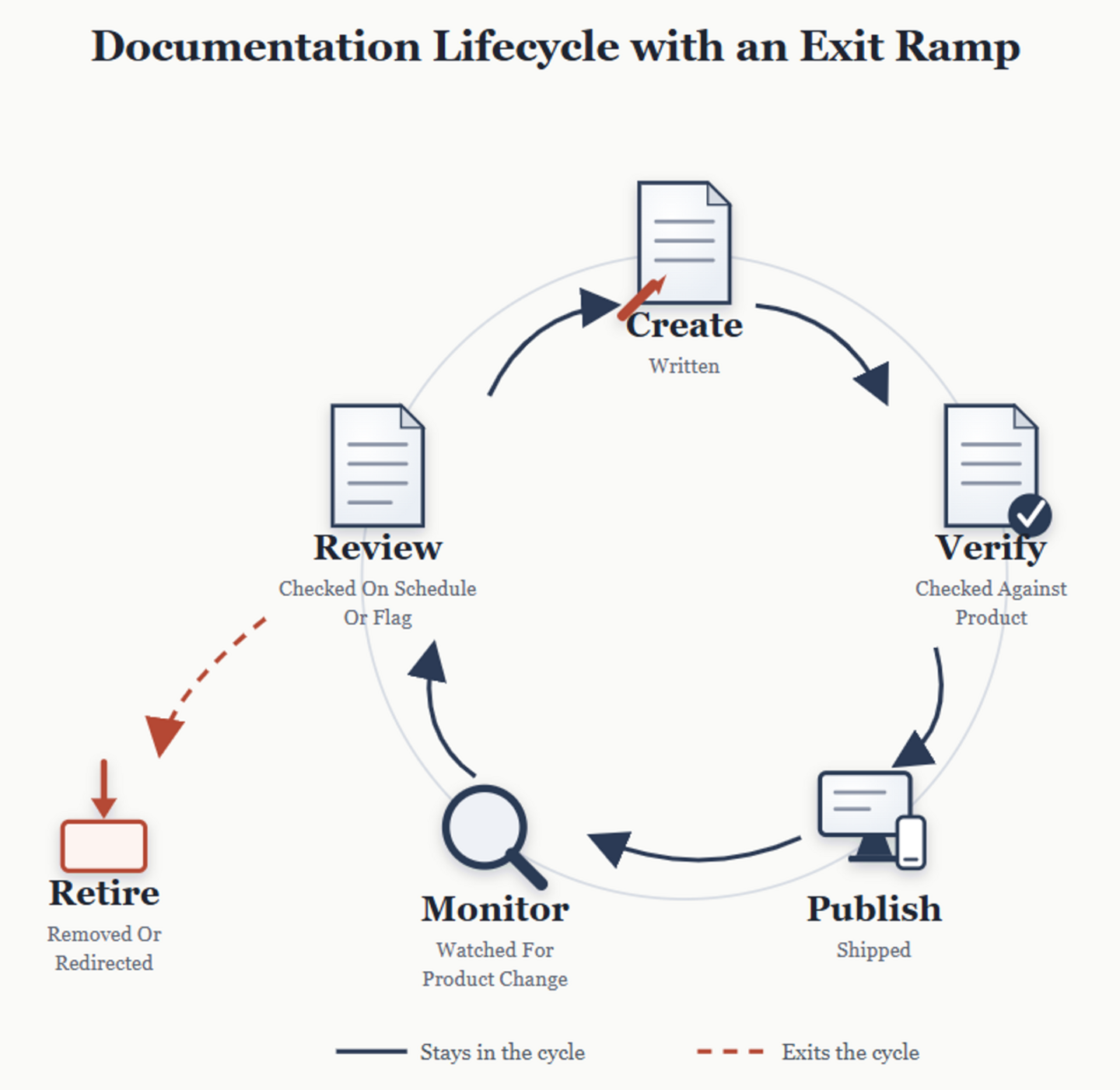
Adding those stages changes the shape of the process, not just its length. It's no longer a clean loop. Content that gets reviewed can be updated and put back into circulation, looping back into the cycle. Content that gets retired exits it permanently. The result is closer to a loop with an exit ramp than a circle. This means that most content keeps moving through create, verify, publish, monitor, review, and back again. Meanwhile, some content needs to be retired and thus leaves the system for good. A documentation process without these additional states isn't broken; it's just incomplete. And from a documentation debt perspective, the lack of these stages means nothing is being done to prevent debt from building.
Where This Leaves Us
Before you can manage documentation debt, you have to be willing to say, plainly, that it exists. You have to accept that somewhere in your content right now, something is confidently telling your users the wrong thing.
Once it is acknowledged, the next step is planning how to identify, monitor, correct, or retire content effectively within the documentation lifecycle, which will be covered in my next article: “Reducing Documentation Debt: Find It, Fix It, Manage It”, published after tcworld conference.